
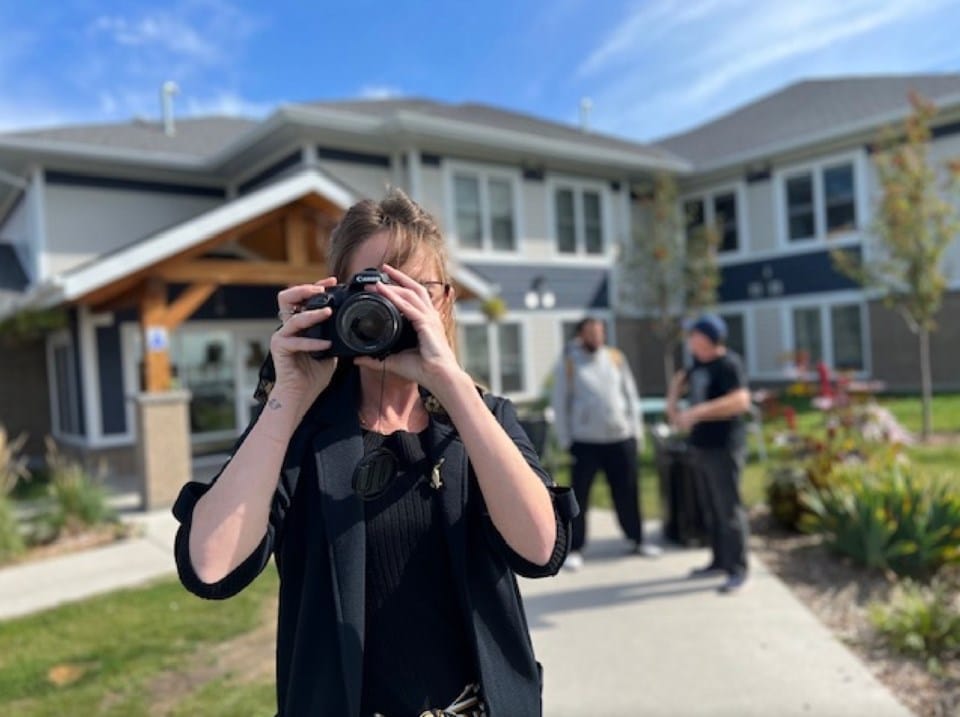
Dakota shares story of homelessness, well-being journey; ‘I’m not healed yet, but I am independent, safe and extremely happy,’ she says.
This is the 12th in a series of columns written by staff from the Lighthouse to help the community better understand people experiencing homelessness and those who support them. This column will appear every other Monday.
Note from the authors: Sharing stories of people who have experienced homelessness is a privilege. It is also extremely important for people who have never been without a home to read the stories of what it can actually be like living on the street, in shelter or in supportive housing. We were honoured to sit down with Dakota to listen as she passionately shared her story of survival, resilience and hope.
Meet Dakota. Her journey brought her to the Lighthouse more than three years ago and, as she says, “I’ll be a shelter mate and an advocate for life.”
Dakota first came to the Lighthouse while the shelter was operating out of a local hotel. The COVID-19 pandemic had recently started, and the Lighthouse had opened a women’s shelter in order to care for women who were vulnerable and without anywhere else to go.
When she arrived, Dakota wasn’t able to trust many people. Her faith in humanity was shattered due to the trauma she had experienced. Many of the relationships in her life had broken down or disappeared when she experienced homelessness.
She had experienced challenges within the system that was supposed to help her, and the flaws in the system were disheartening.
“There’s a lot of footwork and movement when navigating the system,” Dakota says. “It’s exhausting.”
But she knew how she came out of that experience was up to her.
“The experience of homelessness is a degrading experience in and of itself, never mind the circumstances that lead to an individual becoming vulnerable to begin with,” she says. “It’s a lot to process.”
That’s why she decided to build her own safety net.
Throughout her time at the Lighthouse, the goal was to make change. Despite the mental anguish of experiencing homelessness and all that comes with it, Dakota knew she didn’t want to rely on others for her housing or well-being going forward.
“When you’ve been abused mentally, emotionally, financially, physically and spiritually, it tears you down and destroys your identity. You have to create a new character and adapt new, healthy ways of thinking,” she says.
She began to develop her skills and add ‘tools to her toolbox.’
Dakota also started a business during her stay at the shelter, and she landed some side jobs in a new field. No one at those jobs knew she was homeless at the time, and that was the beauty of it. Dakota says shelter is so important because “it allows people the space and time to organize their lives and work through their personal challenges.”
Dakota left the shelter after a few months, and she moved into a market rental.
“After leaving the shelter back in 2020 to rent a room, I was still struggling to afford my basic needs,” she shares. “My pension benefits don’t cover my medicine or the services I require. My mental health was unstable, and I recognized that.”
She again found herself with nowhere else to turn, and she returned to the Lighthouse shelter until moving into the Lighthouse’s supportive housing building shortly after it opened in the fall of 2021.
When asked what living in supportive housing was like, she said it was the space she needed to process and figure out her thoughts. She was able to grow her emotional regulation skills. It allowed her to manage effectively in her transition into independent living and continue on her journey.
Supportive housing was also the place where her physical recovery took a turn for the better.
“I was really banged up coming into the shelter. I lost mechanical use of my extremities and functioning failure on one side of my body. I needed medical attention and a space to recover from surgery and procedures,” she says.
There’s a lot of hurt, and the physical and emotional pain has effects on all parts of life.
The expectations and boundaries that were in place in supportive housing were “helpful and easily manageable,” says Dakota. Meeting with her workers allowed her to work with them to set and reach goals.
“I took the initiative, and they supported me,” she says. “The first time I cooked at supportive housing, it was probably the worst soup, but I did it. That feeling of accomplishment and pride in myself is really what I ate up that night.”
Dakota also highlighted the resources that were available to her throughout her time at the Lighthouse. Even just walking down the hall, there was information about relevant phone numbers, webinars, and classes for all aspects of recovery, and Dakota used these resources.
“I got my money’s worth,” she said with a laugh about the program fees.
Dakota’s trust in people has been restored bit by bit, though she says it is still sometimes hard to trust others. She continues to heal and work on herself every day.
She stresses the importance of staff who are genuine in their work. She experienced this at the Lighthouse, thanks to shelter workers who showed they cared and supportive housing workers who supported her goals. The passion staff have makes all the difference because they deal with a lot on a daily basis, and participants see this. But they also see the results and benefits of supportive staff. Like Dakota says, “Staff got me through. Period.”
After living in supportive housing for a year-and-a-half, Dakota moved out into market housing in June 2023. She’s excited about the fireplace and the dishwasher she has. She has relocated to another city, and she indicates this is part of her healing journey.
“You can’t heal where you were broken. I’m not healed yet, but I am independent, safe and extremely happy. That is my goal,” she says.
Housing is just one element of an individual’s needs. Recovery isn’t over when you leave the Lighthouse. Not even close.
Dakota wants to highlight there is assistance for individuals and their accommodation. Her apartment is partially funded by the Canada-Ontario Housing Benefit she receives. This subsidy is a blessing that has allowed her to be able to afford her living situation, but it won’t last forever. What happens when the subsidy runs out? Dakota is intentionally planning for that future. She intends to work for herself and will continue to build her business and brand. She recently purchased a good-quality camera, thanks to a bursary she received for continuing education. She’s excited to learn to use it well.
“I plan to capture all my milestones and adventures as I start my new life post-trauma, -pandemic and -shelter. A clean slate is not to be taken for granted,” she says.
Dakota shares she will continue to advocate for people who are experiencing homelessness. She’s working out how she can and will get involved.
“It can be a lot of politics, but people’s lives are at stake in the meantime,” she says.
It’s important to listen to people who have experienced homelessness because “when it’s outside of your realm of experience, you have no concept of what it’s actually like or how to manage it,” Dakota says.
She is looking for societal changes and calling for reform in the systems and resources available in the community.
Dakota describes the Lighthouse as “home.” It’s a safe place. As a kid, when her dad was logging, he would tell her to get up on the rocks so he would know she was safely out of the way of being trampled or caught in the logs.
Dakota still sees her safe place as the rock, and the Lighthouse has become that for her. She may not yet know exactly how she’ll be interacting with it going forward, but she says you “better believe I will be attending the golf tournaments and events. I just need to develop a little more.”
Dakota also thanks her shelter and supportive housing mates as well as the community for their generosity and all the kind and thoughtful wishes of support along the way.
“No disrespect,” she says, “but I hope I never come back to (the Lighthouse to) stay.”
It’s a privilege to share Dakota’s story of hope, and we look forward to seeing her future.
Linda Goodall is the former executive director at the Lighthouse.
Rosemary Petersen is the assistant director at the Lighthouse.