
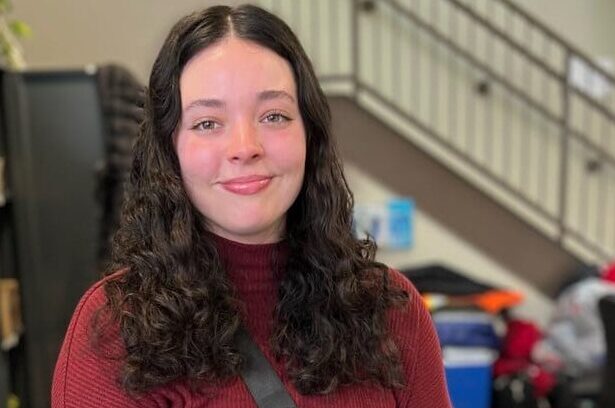
Ines, who battled addiction since she was 13, is now a shelter worker; ‘I knew that I couldn’t live like I was,’ she says
This is the 22nd in a series of columns written by staff from The Lighthouse to help the community better understand people experiencing homelessness and those who support them. This column appears every other Monday.
What is it really like to experience homelessness?
Some of us have been homeless in our lives. Many of us have not. So, how do we understand it? At The Lighthouse, we know that in order to serve people well, we must be willing to listen and learn.
We had the chance to do just that as Ines shared her story.
Ines was a volunteer who moved into a staff position as a shelter worker at The Lighthouse. As someone in her early 20s, her story reflects the harsh realities faced by many young individuals grappling with homelessness, demonstrating the complexity of their situation.
Ines grew up in Toronto. Her mom was a single parent, and they struggled with their relationship. Late one November night at age 17, it became evident Ines could no longer stay at her mom’s.
“They gave me 10 minutes to pack a bag and said that we were going,” she said. “I remember asking police where they were taking me, but it was a long, quiet ride.”
Ines was dropped off at a youth homeless shelter in North York. She completed the intake, but she didn’t want anyone to know who she was.
“I created an alias. I had to be tough,” she said, noting adjusting to life at a shelter was challenging. “I kept to myself, but drugs and violence were really common. There were nights that I didn’t sleep.”
Ines had been fighting addiction since she was 13. At 16, she began a relationship with a guy that caused a lot of trauma and some unhealthy coping mechanisms, including increasing her substance use.
When she was 17, she was diagnosed with fibromyalgia. At the time, doctors told her she would only ever experience temporary relief through things like massage, acupuncture, and opioid medication. For someone who was already addicted to opioids, it simply added to the struggle.
Against many odds, Ines managed to complete high school, though it was difficult to stay motivated. She switched to an arts-tailored school for her last semester of high school, and it was the first time she actually enjoyed her education.
Ines moved from the shelter to a group home while still in school.
“Everything was going pretty good, but then COVID started. We were in lockdown, and I became isolated and depressed. School had been my escape,” she said.
As she struggled with her mental health, disordered eating, and her relationship breaking down because of the lockdown, Ines was also still living with her benzodiazepine and opioid addiction.
“A lot of the drugs I bought were fake,” she said, “and I never really knew what I was getting. I was also prescribed a lot of meds, and I learned how to abuse them. The group home had control of some of my meds, so I would plan it out to save them and be able to take multiple later.”
Ines struggled to trust anyone. The lack of stability in her life had a major impact. Needing to leave the group home when she turned 18, she moved to a transitional shelter. She tried to stick to herself, but she still wanted connection with people.
She wanted more — more stability, more happiness, more friends. She started to work, but it was hard to maintain a job because she still wasn’t well.
“I ended up at the hospital, and they said I was fine, but I wasn’t. I was in psychosis — I felt completely powerless and without control,” she said. “There was a medical scalpel within reach, and I grabbed it. I lost consciousness immediately because of how much blood I lost, and ended up with multiple stitches.
“But I still wasn’t admitted because the shelter was considered stable, even though they couldn’t provide the kind of support I needed. I was discharged in a hospital gown and rode the bus back.”
Ines shares that she felt failed by every system. She didn’t have hopes or goals for her future, and she didn’t feel like she was capable. She was also experiencing some abuse through a situation that left her traumatized. No longer able to stay at the transitional shelter because of increasingly difficult behaviour caused by her addictions and abuse, she was asked to gather her things and leave.
“It’s a terrible feeling that you only have a backpack of things. I was attached to things because they felt like stability and safety and comfort,” she said.
As she sat alone on the sidewalk that day in May, she got a call from government housing.
“It was an assessment to put me on a priority list. They had a new building they had opened with the YWCA that was for women fleeing abuse,” she said. “Looking back at that, what are the odds that they would contact me at that moment?”
But it wasn’t an immediate solution, and she still needed to find somewhere to stay that night.
Ines slept in a park for a couple of days, and then moved to a beach. Her phone was stolen, and all she had were two pocket knives for protection. She went three days without food. Someone told her about a drop-in centre that offered free food, and he offered to watch her stuff while she went.
“I had to make the decision to trust him or to just suffer,” she said.
He turned out to be a “guardian angel,” she said.
Thanks to that man’s encouragement, Ines found an old stroller someone had thrown away, a tarp and some rope that would help her secure her belongings and make it easier to move around.
Eventually, Ines decided it was time to try staying at a homeless shelter again. It was difficult to adjust.
“I was 106 pounds, malnourished, and I was just eating pills. I was constantly in fight or flight. Taking the pills made me feel stronger and invincible,” she said.
Despite being robbed, having a knife held to her stomach, and getting involved in further violent situations, Ines made it through. By July of that year, she had moved into subsidized housing.
Although she had her own apartment, she was still struggling and unwell. She decided to reconnect with her mom.
“We met for lunch because I didn’t want her to know where I was living. She saw a different version of me — I had tattoos and scars, and I was thinner than before. She tried to support me, and sometimes I would stay at her place, but I was a free bird,” she said.
Ines’s mom began talking about a rehabilitation program for youth. Eventually, Ines agreed to go.
“I knew that I couldn’t live like I was. At first, I decided to do the program for my nana,” she said.
Ines started the program at Pine River Institute on Feb. 1, 2022. It began with her spending seven weeks in the woods. The goal was to ensure the youth became grounded and became invested in the program.
“The withdrawal was terrible, but I feel so blessed that I got that opportunity,” she said.
A year later, as part of the program, Ines moved to Orillia and began volunteering at The Lighthouse. She loves Orillia because it’s small and quiet compared to Toronto, and she doesn’t have to worry about running into people from her past.
She completed the program and moved into her own apartment. Not long after that, she started working at The Lighthouse.
From her experience using shelter services to now providing similar services, Ines sees the difference support makes in the lives of people who are experiencing homelessness. While she doesn’t understand everything participants are going through, she “can understand and relate to some of it” and she knows “what helped in the system and what didn’t.”
Tools like success plans, meeting with housing workers, and the input of the entire team are all ways Ines sees The Lighthouse ensuring participants have what they need to secure housing.
She recently celebrated two years sober, and she plans to begin an education in social service work in the fall.
“There have been a lot of times that I was close to death, but if I can fight so hard for my addiction, let me try to fight for something good,” she said.
Ines looks toward her future with hope, and we look forward to seeing the difference she will continue to make.
We are grateful Ines is part of our team. Knowing how critical support and community are when experiencing homelessness and/or addiction, The Lighthouse will continue to provide hope to youth in our community — youth like Ines.
Linda Goodall is the former executive director at The Lighthouse. For further information contact Dale Rowe, Executive Director at dale@orillialighthouse.ca
Rosemary Petersen is the assistant director at The Lighthouse.