
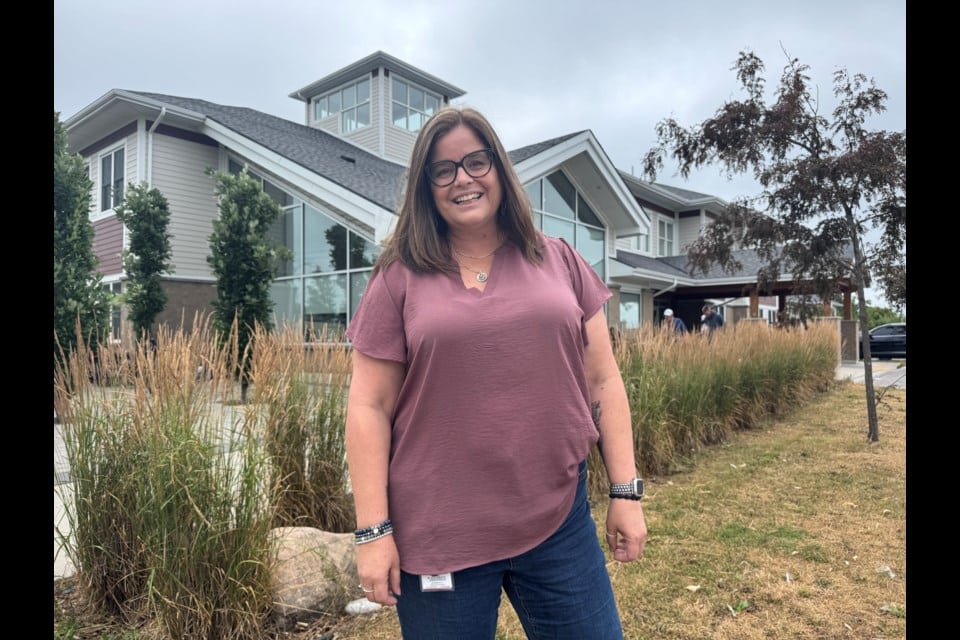
Linda Goodall, who led The Lighthouse through unprecedented growth and crisis response in Orillia, has announced her decision to step away from her role
After nearly a decade of service, leadership, and unwavering compassion, Linda Goodall is preparing to step down as executive director of The Lighthouse, the organization she helped guide from a small grassroots shelter to a multi-facility, life-saving operation at the heart of Orillia’s response to homelessness.
“It’s time,” Goodall says with a calm certainty that’s clearly been earned. “I have mixed feelings, of course. I love the team. I love the participants. I love what we’ve built here, but I’m at peace with my decision. I’ve always said I wanted to leave well, and I believe I can.”
Goodall’s departure, currently scheduled for the end of October, comes not with a new job waiting in the wings, but with a commitment to ensure the Lighthouse transitions smoothly to new leadership. She’s serving on the transition committee, and says she’s prepared to stay a little longer if that’s what’s needed to see the process through.
“I didn’t want to leave in burnout or crisis,” she explains. “And that was a very real possibility at points over the last ten years. I’ve been hospitalized for bipolar disorder, I’ve had cancer, and I’ve had to battle through some of the hardest moments of my life while doing this job. But I never felt like it was time to go, until now.”
Goodall joined the Lighthouse in 2015 as part of the Building Hope campaign, a community-driven initiative to expand and modernize services for people experiencing homelessness. At the time, the organization had six staff, a $150,000 budget, and shelter space for just eight men. The goal was modest but important, to relocate from the small shelter on Peter Street and add beds for women and youth.
What followed, under Goodall’s leadership, was a transformation few could have imagined.
Today, The Lighthouse operates two purpose-built facilities and runs 12 distinct programs, including emergency shelter, transitional housing, mental health support, community meals, outreach services, and a medical clinic. Its operating budget has grown to $4.3 million. Its team has expanded to 85 staff and over 150 volunteers, and on any given night, as many as 110 people sleep under its roof.
“I remember the day it really hit me,” Goodall says. “I walked in and saw Canada Post delivering mail, Gordon Food Service dropping off food, a volunteer chatting with a participant at the front desk, a doctor talking to someone in the clinic, and I realized, I didn’t know what was happening in every corner. That meant it was working without me. That’s when I knew we had built something incredible.”
The scale of that growth is staggering, and yet, as Goodall is quick to point out, the expansion was never about numbers; it was about meeting a growing need.
“The reality is, the need exploded,” she says. “The housing crisis, the opioid epidemic, and COVID all hit at once. But because we had already begun building, we were ready. We didn’t bring these challenges here; we were prepared to respond.”
Even with those systems in place, the work is far from easy. Goodall acknowledges that the emotional toll of leading the Lighthouse has been immense.
“At the beginning, I was doing front-line work, trying to build the organization while helping participants at the same time,” she says. “You see a lot, you carry a lot. Overdoses, deaths, people at their lowest. It’s impossible not to take some of it home.”
What helped, she says, was knowing the Lighthouse was doing everything it could.
“That’s how I sleep at night,” she said. “Even when the worst happens, and sometimes it does, I know we did everything in our power to support that person. That matters.”
Goodall’s own struggles with mental health have given her a deep empathy for the people she serves. She’s been candid about her experience with bipolar disorder, including multiple hospitalizations, and says being open has made her a better leader.
“There’s this idea that you can’t be a strong leader and talk about mental health,” she said. “I reject that. Being vulnerable makes space for others to be vulnerable too.”
One of her most powerful memories came during a hospital stay, when she was admitted to a psychiatric unit. Upon arriving, she was recognized by a participant from the Lighthouse.
“He looked at me and said, ‘Linda, like the boss?’ And I said, ‘I’m just Linda. I’m human.’ Our lives were so different. I had a family, benefits, and a job to return to. He had no one. When I left, I went home; he went back to the street. That moment changed me.”
It reinforced that everyone, regardless of circumstance, deserves dignity, support, and a chance to heal.
When asked how her view of homelessness has changed over the years, Goodall is direct.
“I understand the trauma more now,” she says. “When someone tells you their mother gave them a crack pipe at five years old, and then someone else says, ‘Why doesn’t he just get a job?’, you start to see how deeply misunderstood this issue is.”
She’s seen that stigma play out in the community, too. Critics have claimed the Lighthouse “enables” homelessness or draws people to Orillia. Goodall pushes back firmly.
“We’re not bringing people here. We’re responding to the people who are already here,” she says. “If we closed our doors today, we’d put 80 people on the street. Where would they go?”
Many of the people the Lighthouse serves are local, she explains. Others left Orillia years ago because services didn’t exist, and returned when they finally did. Some bounce between communities because shelters in nearby towns fill up or close.
“This is a national crisis,” she says. “It’s not just an Orillia problem. But we are part of the solution.”
Goodall describes her leadership style as “servant leadership”, one rooted in empowerment rather than control.
“I’ve never seen myself as ‘the boss,’” she says. “I want people to feel empowered to lead, to make decisions, to grow. I want our staff to understand our values so well that they can lead from wherever they are.”
That philosophy has helped shape a workplace culture where staff and volunteers feel supported, and where trust is everything.
“I’ve had team members who can tell when I’m off, and they’ll say, ‘You should go home.’ And I do the same for them,” she explained. “We take care of each other.”
She believes that the relational approach is especially important in high-stress environments like shelters.
“Culture is everything,” she says. “If we’re going to support people in chaos, we need to support each other first.”
If there’s one story that embodies Goodall’s approach, it’s the man who left the Lighthouse in a fury one winter and called later to say he hoped he’d die, and that it would be her fault.
“He said things I can’t repeat,” she recalls. “But a few days later, he came back and apologized, and we had this beautiful conversation. He was still on a service restriction, but he knew he was welcome back.”
The experience affirmed that everyone deserves a second chance and that anger often masks deeper pain.
“We talk about self-regulation with our team,” she says. “When someone lashes out, it’s not always about us. It’s about what they’ve been through.”
She wants people to remember that “everyone has a story,” whether they’re on the street or behind a desk. And she encourages the community to stay curious, not judgmental.
“If you don’t understand something, ask,” she says. “It’s okay not to know. But it’s not okay to judge without understanding.”
As for what comes after the Lighthouse, Goodall isn’t sure, and she’s okay with that.
“I’m not retiring,” she says, smiling. “I’m only 52, almost 53. I’ve worked in a nonprofit my whole life. I’ll be back, but I think I need a break from the weight of this role.”
She plans to stay in Orillia, and hopes to return to volunteering, something she hasn’t had time for in years.
“I might help with Coldest Night of the Year again,” she says. “Or finally get involved with my church.”
And while she’ll give the new executive director space to lead, she’s happy to stay involved if they need advice or support.
“I’ll always be part of this place,” she says. “Just in a different way.”
When asked how she hopes to be remembered, Goodall paused.
“Years ago, someone told me I was too kind to be a leader. I disagreed,” she said. “A few years later, they came back and said, ‘You were right.’”
“I hope I’m remembered as someone who led with kindness and compassion,” she said. “That I helped build a culture where people could be real and that we made a difference.”
Her message to the community is to keep supporting the Lighthouse.
“It exists because of you,” she said. “The people we serve aren’t ‘others.’ They’re part of this community. They’re your neighbours, your classmates, your coworkers. Everyone has a story, and everyone deserves a chance.”
Goodall says she believes that God brought her to the Lighthouse and sustained her through the growth, helping to meet the increasing needs.
“I couldn’t have done it without him helping me through all my personal challenges,” she said. “I am now fully trusting him with my next chapter.”
If you are interested in stepping into the executive director role, click here.