
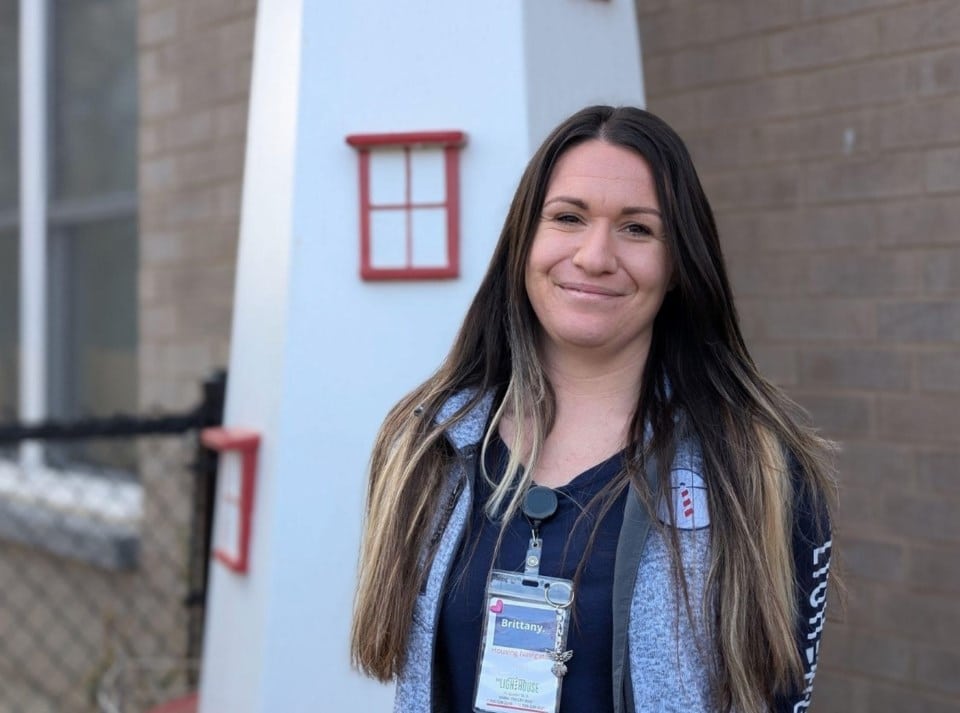
‘I just remember that someone saw the good in me. Now I want to do the same for others,’ says Brittany, a housing navigator with local organizat
This is the 40th in a series of columns written by staff from The Lighthouse to help the community better understand people experiencing homelessness and those who support them. This column appears every other Monday.
Today, I want to share a powerful story of hope and transformation. It’s a story that begins with addiction and struggle, yet it ultimately demonstrates the perseverance, determination and support that can bring lasting change in someone’s life.
Meet Brittany, a housing navigator at The Lighthouse who works with people experiencing homelessness to help them find hope for their futures and take the necessary steps to secure housing.
Brittany’s passion for working in the social service sector comes from her own life experiences.
“I grew up in a broken home,” she shares, “and I experienced sexual abuse for about nine years as well as witnessed other people self-harming.”
As a teenager, Brittany looked for ways to cope with her childhood trauma.
“I was partying a lot. I would run away from home, and I spent some time sleeping in youth shelters, sleeping on the streets with my friends, and doing a lot of unsafe stuff.”
Brittany’s struggle with substances began after she had her wisdom teeth removed. She was prescribed Percocet for the pain, “and they made me feel really good,” she says. What started as a prescription soon turned into a dependence and then an addiction. As her addiction to hard substances deepened, her relationship with her family crumbled and her daughter was taken from her care.
“You’d think losing my daughter would have been an eye opener for me,” Brittany says, “but it just made me feel worse about myself and go deeper into my addiction to cope with that trauma, too.”
Without her daughter, Brittany lost some of her financial resources, including the Child Tax Benefit, and fell behind on her bills, eventually losing her apartment and living out of her car.
“I would couch surf at friends’ places or get a hotel room when I had money,” she says.
Eventually, she decided she needed a change.
Brittany made the decision to start fresh in Orangeville, a town where she had a connection that felt like a refuge for her.
“My dad’s friend lived there, and he’s like an uncle to me. He had always been a really good part of my life, and he was the only place I thought I could go,” she recalls.
While he gave Brittany a place to stay, he also pushed her to face the truth of her situation, challenging her to get out of her addiction.
“He wouldn’t put up with my crap. After he kicked me out one time, I realized I had to take some responsibility, so I decided to do something about it. I called CMHA (the Canadian Mental Health Association) and got connected with RAAM (rapid access to addictions medicine).”
Through a Suboxone treatment program designed to address the use of short-acting opioids, Brittany began to reclaim her life.
She stayed in a shelter in that area for a period of time, and as she began to deal with her addiction, she knew she also needed to address her emotional well-being.
“For me, addiction was about numbing everything,” she reflects. “I wanted to numb all of the pain that I had felt and suffered. I had to deal with my trauma in order to overcome the addiction.”
With the help of a trauma counsellor, Brittany began to work through her past and her addiction. It was an agonizing process, physically and emotionally, but through it, she learned to accept her pain without letting it define her.
“Trauma therapy helped me overcome those inner demons. Having someone to help me process the trauma and those feelings meant I was able to learn to accept it and not dwell in it.”
Brittany found work at a factory, regained her independence and custody of her daughter, and she later decided to return to school. She attended the social service worker program at Georgian College. Her desire is to help others, and the opportunity to gain professional experience in addition to her lived experience, have allowed her to become equipped to actively listen and support people who are experiencing homelessness or struggling with addiction.
Brittany’s journey led her to The Lighthouse, where she began a student placement.
“The Lighthouse wasn’t on my list of agencies where I wanted to do a placement, but my placement co-ordinator thought it would be a good fit. I knew this was where I wanted to be as soon as I started getting to know the people,” she says.
Brittany brings a hopeful perspective to her work.
“I see the good in everyone. I’m a positive person, and if I can be part of getting someone off the street, guiding them, or having a conversation that makes their day just a little bit better, that’s what I want to do.”
She believes in an unconditional positive regard, allowing her to hold on to hope that people’s lives can change.
“I just remember that someone saw the good in me. Now I want to do the same for others.”
Homelessness and addictions are not the entirety of anyone’s story. As Brittany says, “They’re not just a person on the sidewalk. They are more than their addiction. They have dreams, families, and things that they love. They have people who are still hoping and praying for them. That gives me hope.”
Join us as we offer hope for people who are experiencing homelessness in our community. Your support of The Lighthouse can make a lasting difference. To donate and offer hope for the holidays, visit orillialighthouse.ca/christmasdonations.
Rosemary Petersen is the managing director at The Lighthouse and can be reached at rosemary@orillialighthouse.ca.